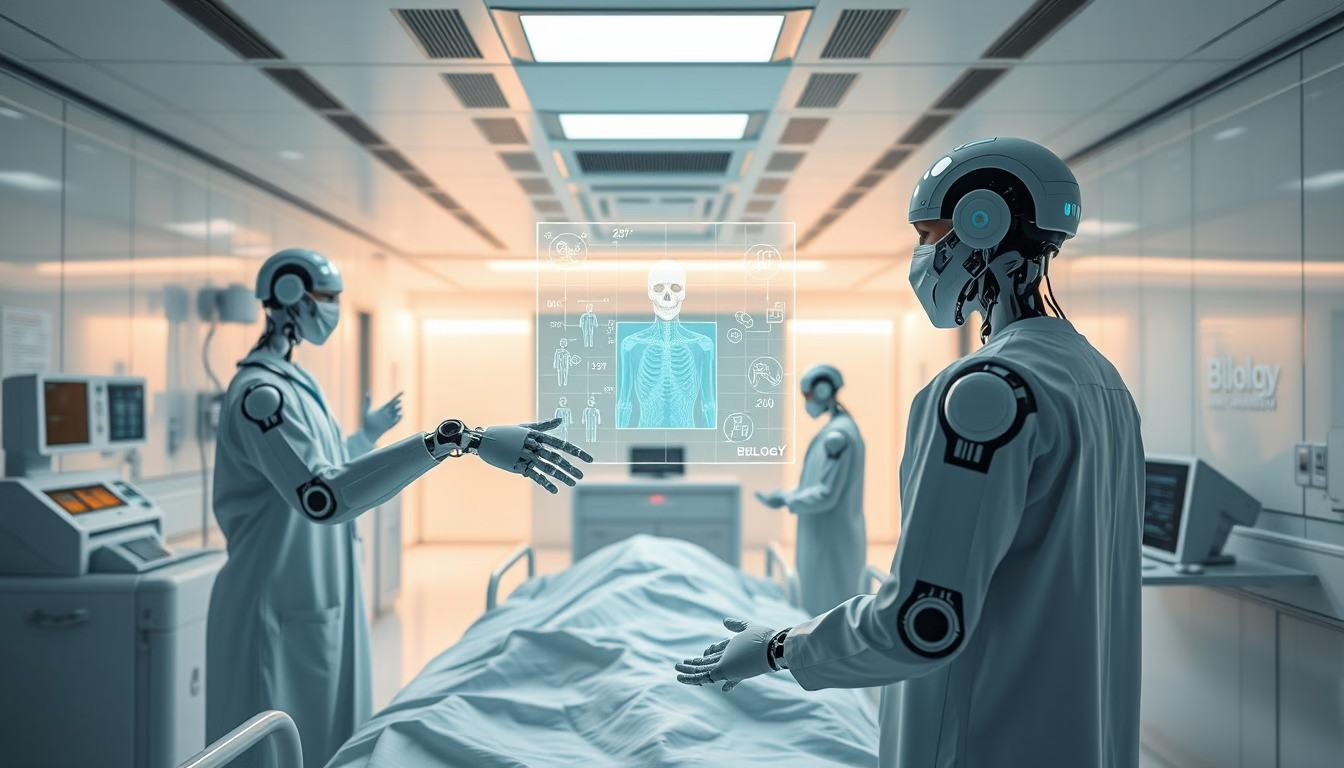

Machine Learning vs Deep Learning
Machine Learning vs Deep Learning Key Differences Today. Artificial intelligence (AI) has changed how we use technology. Machine learning and deep learning are two key areas within AI.
Knowing the differences between them is crucial for both businesses and individuals. Machine learning uses algorithms to learn from data and make predictions. It doesn’t need to be programmed for each task. It creates statistical models to find patterns and make decisions based on data. Deep learning, inspired by the brain, can handle complex data with great accuracy.
Key Takeaways
- Machine learning and deep learning are both subsets of artificial intelligence, with deep learning being a specialized form of machine learning.
- Machine learning relies on algorithms to learn from data and make predictions, while deep learning uses complex neural networks to process and analyze unstructured data with higher accuracy.
- Deep learning requires larger amounts of data and more computing power compared to machine learning, but it often yields superior results for complex tasks.
- Machine learning can operate on smaller data sets and be performed on CPUs, while deep learning typically requires specialized GPUs for training.
- Artificial intelligence encompasses a wide range of disciplines, including computer science, data and analytics, software engineering, and philosophy.
Understanding Artificial Intelligence Fundamentals
Artificial intelligence (AI) is a field that lets machines solve problems and think like humans. It uses computer science and data processing. From simple chess games to complex algorithms for vaccine development, AI has grown a lot.
The Evolution of AI Technology
Since 2012, the AI industry has grown a lot. It moved from a slow start to a big expansion. This growth is thanks to better GPUs that make AI faster and cheaper.
Core Components of Modern AI
Modern AI has two main parts: machine learning and deep learning. Machine learning lets tech do tasks as well as humans. Deep learning, inspired by the brain, is great at handling different kinds of data.
Role of AI in Today’s Technology
AI is key in many areas, like streaming services and self-driving cars. It’s used for many tasks, but machine learning is best for data tasks. Deep learning is top for complex tasks like recognizing images and understanding language.

As AI keeps growing, it’s vital to grasp its basics and its impact on today’s tech.
Machine Learning vs Deep Learning: Essential Comparisons
The field of artificial intelligence has grown a lot. Machine learning and deep learning are now key parts of it. Knowing how they differ is important for using them well in different areas.
Machine learning lets computers learn from data without being told how to do it. It’s a way for systems to get better at doing a task over time. Deep learning, on the other hand, uses a special kind of algorithm called a neural network.
One big difference is how they handle data. Machine learning often needs humans to prepare the data first. Deep learning, however, can automatically find the important parts of the data. This makes it great for things like recognizing images and understanding language.
| Characteristic | Machine Learning | Deep Learning |
|---|---|---|
| Data Requirements | Can work with smaller datasets | Typically requires large amounts of data |
| Feature Engineering | Involves manual feature extraction | Performs automatic feature extraction |
| Interpretability | Generally easier to interpret | Offers higher accuracy but can be more complex to interpret |
| Applications | Suitable for structured data patterns, classification, and recommendation systems | Excels in processing unstructured data, such as image recognition and natural language processing |
Choosing between machine learning and deep learning depends on the problem and the data available. Deep learning is great for hard tasks but needs lots of data and computing power. Machine learning is better for simpler tasks and when data is limited.

As AI keeps growing, machine learning and deep learning will play a big role in tech’s future. Knowing their strengths and weaknesses helps us use AI better and solve digital age problems.
Fundamentals of Machine Learning Explained
Machine learning is a key part of artificial intelligence. It lets computers learn and get better over time without being told how to do it. This method uses big datasets to find patterns and make smart guesses. It includes different ways to learn, like supervised, unsupervised, and reinforcement learning, each with its own strengths and uses.
Supervised Learning Methods
Supervised learning uses labeled data to train algorithms. This means the data comes with the right answers or outcomes. This way, the model learns how to predict things it hasn’t seen before. Some common algorithms are linear regression, decision trees, and support vector machines.
Unsupervised Learning Approaches
Unsupervised learning works with data that doesn’t have labels. It helps find patterns and structures in the data on its own. It’s great for tasks like grouping similar data points together, finding odd data points, and reducing data size. Algorithms like k-means clustering, hierarchical clustering, and principal component analysis are used here.
Key Machine Learning Algorithms
Choosing the right algorithms is crucial for machine learning success. Important ones include linear regression for making predictions, decision trees for classifying and predicting, and random forests for better accuracy. Support vector machines are also key for solving both simple and complex problems. These algorithms help in many areas, like predicting sales, catching fraud, and suggesting products.

“Machine learning is the science of getting computers to act without being explicitly programmed.” – Arthur Samuel, Pioneer of Machine Learning
Deep Learning Architecture and Neural Networks
At the heart of deep learning are artificial neural networks. These networks are like the human brain, with interconnected nodes or “neurons.” They work together to process and learn from data. Artificial neural networks have an input layer, hidden layers, and an output layer.
Deep learning systems have more hidden layers than simple neural networks. This lets them capture complex patterns and representations. The more layers, the more complex the data they can handle.
Convolutional neural networks (CNNs) are great for images and videos. They have layers that help identify and extract features from visual data. On the other hand, recurrent neural networks (RNNs) are perfect for handling sequential data like language and speech.
Deep learning systems have many more parameters than simple neural networks. This makes them more demanding to compute but also lets them learn complex patterns. Choosing the right neural network architecture is crucial for a task’s success.
“Deep learning has been a game-changer in the field of artificial intelligence, enabling machines to learn and process data in ways that were previously unimaginable.”
The growth of deep learning is thanks to big datasets, more computing power, and better algorithms. As AI, machine learning, and deep learning become more common, we see big changes in many industries.
Data Requirements and Processing Power
Machine learning has grown, leading to deep learning, which comes with its own set of challenges. One key difference is the amount of data needed. Traditional machine learning works well with smaller datasets and doesn’t need top-notch hardware like GPUs. But deep learning needs huge amounts of data to train its complex models, unlike traditional methods.
Big Data in Deep Learning
Deep learning models can find important features in big, varied datasets. They can handle tough tasks like recognizing images and speech, processing language, and robotics. But, they need a lot of computing power, like GPUs or TPUs, more than traditional methods.
Computing Infrastructure Needs
Traditional machine learning works well with libraries like sickest-learn and standard CPUs. But deep learning needs special tools like Tensor Flow and Pitch for neural networks. This makes it hard for organizations with limited resources or tech skills.
Storage and Processing Considerations
Deep learning needs lots of data, which means scalable storage and processing. Cloud computing helps by providing the needed power and storage. It also lets organizations scale resources as needed. Transfer learning has made things easier by using pre-trained models, reducing data needs in some cases.
“Deep learning models usually require greater training time due to their structural and computational complexity compared to traditional machine learning algorithms.”
Performance and Accuracy Comparisons
Machine learning algorithms and deep learning models have different strengths and weaknesses. Machine learning is great for tasks like predicting customer behavior and stock market trends. However, it needs high-quality training data to avoid making mistakes.
Deep learning models, on the other hand, are very accurate when they have lots of data. They’re especially good at recognizing images with over 90% accuracy. Deep learning is used in many areas, like robotics and speech recognition.
Deep learning models have shown they can solve complex problems better than other methods. But, they need a lot of data to train well. This can be a problem when data is hard to find.
Deep learning models also need a lot of computer power to work. They can be slow for real-time tasks. Plus, it’s hard to understand how they make decisions. They can also be tricked by fake data, which is a big risk in areas like security.
| Criteria | Machine Learning | Deep Learning |
|---|---|---|
| Data Requirements | Smaller datasets | Larger volumes of data |
| Hardware Requirements | Lower | Higher |
| Training Time | Seconds to hours | Hours to weeks |
| Feature Engineering | Experts select important features | Handles feature extraction automatically |
| Data Type | Tabular data | Unstructured data (text, speech, images) |
| Learning Categories | Supervised, unsupervised, reinforcement | Neural networks (CNN, RNN, GAN) |
| Strengths | Cost-effective, business automation, less expertise required | Faster results, flexible inputs/outputs, improves with more data |
| Applications | Predictive analytics, pattern recognition | Social media analysis, banking |
In summary, machine learning is better for simple tasks with structured data. But deep learning is better for complex tasks like image and speech recognition. Deep learning needs more time and computer power but is more accurate. Machine learning is quicker but might not be as accurate for complex tasks.
Real-World Applications and Use Cases
Machine learning and deep learning are changing many industries. They help with natural language processing, computer vision, and predictive analytics. These AI technologies are leading to new ideas and real business benefits.
In crime prevention, deep learning can forecast crime rates with up to 75% accuracy. Machine learning also helps keep data safe, saving companies a lot of money.
Industry-Specific Implementations
Deep learning helps self-driving cars navigate safely by using CNNs. In biotech, it’s key for predicting protein structures, helping with drug development and disease research.
Success Stories and Case Studies
IBM Watson won on Jeopardy, and AlphaGo beat Go world champions. Deep learning also makes document analysis faster and better for finance and insurance.
Future Applications
We’ll see more advanced AI, better self-driving cars, and scientific breakthroughs. Deep learning will also help fight financial crimes with NLP and deep neural networks.
These technologies will improve customer service and make businesses more efficient.
Implementation Challenges and Solutions
Using artificial intelligence, machine learning algorithms, and deep learning models in real life is hard. Companies and researchers face many hurdles. These include bad data, hard-to-understand models, and ethical worries.
Getting good data is a big challenge. In healthcare, for example, data can be missing because of how fast things change. It’s important to know how to deal with this missing data to get accurate results.
Another big issue is making these models easy to understand. As artificial intelligence gets more complex, it’s harder to see how it makes decisions. This is especially true in fields like healthcare. Creating clear AI and setting ethical rules can help solve this problem.
But, there are ways to solve these problems. Using pre-trained models and cloud services makes machine learning and deep learning easier for everyone.
New methods like learning from different types of data and understanding cause and effect can make AI better. These advancements help companies get past the hard parts and use machine learning algorithms and deep learning models to their fullest potential.
“Overcoming the implementation challenges of artificial intelligence is crucial for unlocking its transformative potential in industries like healthcare, finance, and beyond.”
Conclusion
The world of machine learning and deep learning is changing fast. These parts of artificial intelligence are making big changes in many fields. Machine learning has been around since the 1960s. But deep learning has opened up new ways to understand complex patterns and predict things.
Machine learning uses structured data and needs human help. On the other hand, deep learning uses artificial neural networks to learn from lots of unstructured data. This makes deep learning better at things like recognizing images and understanding language. But, it’s hard to understand how these systems work.
These technologies are getting better and will help us make smarter choices, automate tasks, and personalize things. They’re used in spam detection, recommendation systems, self-driving cars, and virtual assistants, among other things. As we use more of these AI tools, the future of predictive analytics and smart systems looks very promising.
FAQ
What is the difference between Machine Learning and Deep Learning?
Machine Learning and Deep Learning are parts of Artificial Intelligence. Machine Learning uses algorithms to learn from data without needing to be programmed. Deep Learning, on the other hand, uses complex neural networks to process data like the human brain does. Deep Learning needs more data and computing power but is more accurate for complex tasks.
What is Artificial Intelligence and how has it evolved?
AI helps machines solve problems using computer science and data. It has grown from simple programs to complex algorithms that predict RNA structures for vaccines. Today, AI includes machine learning, neural networks, and natural language processing. It’s used in many fields, like streaming services and medical diagnostics.
How do Machine Learning and Deep Learning differ in their capabilities?
Machine Learning finds patterns in structured data, while Deep Learning is better at unstructured data. Machine Learning often needs manual data preparation, but Deep Learning does it automatically. Machine Learning works with smaller datasets, but Deep Learning needs more data. Deep Learning models are more accurate for tasks like image recognition but harder to understand.
What are the different learning methods in Machine Learning?
Machine Learning has several methods: supervised, unsupervised, semi-supervised, and reinforcement learning. Supervised learning uses labeled data, while unsupervised learning finds patterns without labels. Important algorithms include linear regression and decision trees. These are used for tasks like classification and regression.
How do Deep Learning models work?
Deep Learning models use artificial neural networks with multiple layers, like the human brain. These networks have input, hidden, and output layers. Each neuron assigns weights to features. Deep neural networks can learn complex data representations. They’re used for tasks like image processing and sequential data analysis.
What are the data and computing requirements for Deep Learning?
Deep Learning needs a lot of data, often millions of points. It also requires a lot of computing power, usually high-performance GPUs. Cloud computing and scalable solutions help with storage and processing. Transfer learning uses pre-trained models to reduce data needs.
How do the performance and accuracy of Machine Learning and Deep Learning compare?
Deep Learning usually beats traditional Machine Learning in complex tasks like image and speech recognition. But, Machine Learning is better for simpler tasks with structured data. Deep Learning is more accurate but takes longer to train and needs more resources. Machine Learning models are faster but less accurate for complex tasks.
What are some real-world applications and use cases of Machine Learning and Deep Learning?
Machine Learning is used for spam detection, recommendations, and fraud detection. Deep Learning is great for computer vision, natural language processing, and autonomous vehicles. Success stories include IBM Watson winning Jeopardy and AlphaGo beating Go champions. Future uses include advanced AI assistants and breakthroughs in scientific research.
What are the challenges and solutions in implementing Machine Learning and Deep Learning?
Challenges include data quality, model interpretability, and ethical concerns. Solutions include better data collection and preprocessing, explainable AI, and ethical guidelines. Transfer learning and pre-trained models help with data scarcity. Cloud-based solutions and AI-as-a-Service platforms make advanced ML and DL accessible to all businesses.